Retired
Feb 2, 2026
I retired last year, after almost 3 decades of working. I'm still new at retirement, but I already have some thoughts about it.
I spent the first 15 years of my career as a software engineer, working in every layer from the kernel to the browser and mobile clients to distributed systems. Code I wrote has been used by billions of people across the world.
I spent the second 15 years of my career as a data scientist / applied scientist / machine learning (ML) engineer, starting over a decade before large language models (LLMs). Across Amazon, Microsoft, Google, and Meta I've:
- designed and analyzed hundreds of online A/B experiments
- trained and deployed hundreds of machine learning models
- debugged ML training and inference
- applied ML to forecast sales and predict consumer behavior
- created hundreds of analyses, metrics, and data pipelines
- invented algorithms and methods
Very many people have asked me, "What will you do?" as if without employment it will be difficult to fill one's time, or as if retirement is the antithesis of doing things, or perhaps enviously boggling at the idea of having any free time at all.
I think it's the wrong question, at least for me. I'm still young at heart. I'm still involved in my community, family, industry advisory boards, and mentoring. I have a massive backlog of tasks that I'm only beginning to make visible progress towards. And as you can see from my home page, I have more hobbies and interests than time to do them all. Anyone who runs out of things to do in retirement isn't thinking clearly. Read a book or learn a new language.
No, I think more useful questions to consider are:
- How will you remain socially connected?
- What does your new search for meaning/purpose look like?
On the first of those, social connection, it's been well-studied that as Americans age, we become more alone.[1] [2] When you retire and fall off the income "cliff," you're also falling off a social cliff! As seen in the image below, coworkers are the group Americans interact with the second most, after spouse/partner.
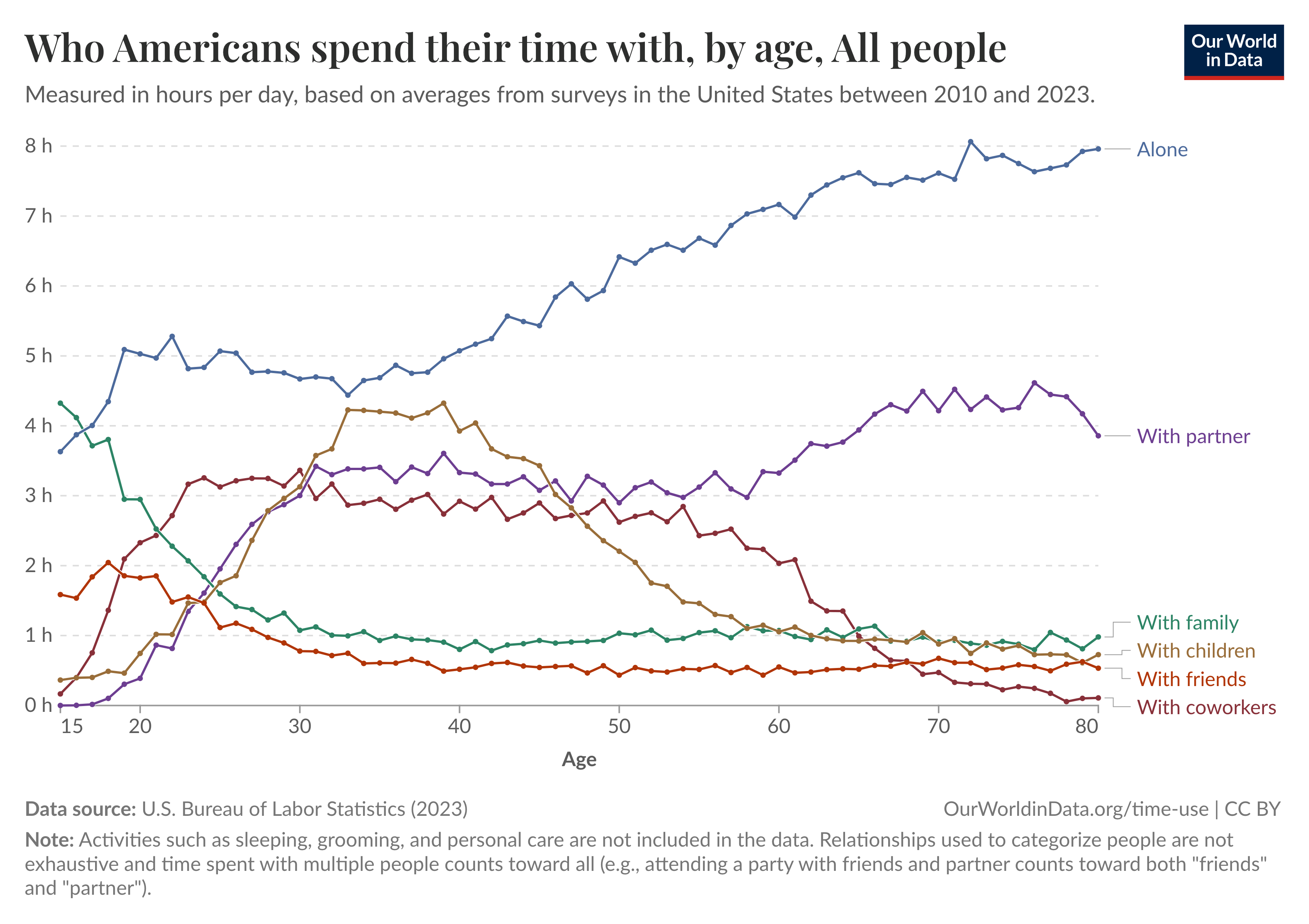
Of course, alone time is valuable too. So often as a working parent of young kids, I longed for a quiet moment. One of the joys of retirement is to have plenty of tranquility. I've enjoyed paddling in a kayak on Lake Washington or reading a book, with zero stress about needing to be anywhere or do anything.
Keeping active socially will no longer happen automatically on its own as a byproduct of going to an office and working with coworkers on projects together: I have to put some thoughtful effort into it! I need people to care about and for me, and I have an intrinsic need to care about others and express that care.
I'm still learning strategies, but setting up regular activites together with friends — meeting for meals or drinks, baking, walks and hikes, travel, playing videogames, hosting parties, etc. — has kept me plenty occupied so far. Most weeks I see several friends. It's definitely not as many hours together as we might have spent together in a 40+ hour work-week, but quality > quantity.
For the second question, finding meaning/purpose, I've talked with many people and read many books about this topic. Man's Search for Meaning: An Introduction to Logotherapy is a particularly thought-provoking book and takes on new meaning when read through the lens of retirement. ChatGPT summarizes the key ideas of logotherapy and this book in part as:
- Humans are driven by the will to meaning, not pleasure or power.
- Meaning is discovered, not constructed arbitrarily
- Meaning is specific to the person and moment.
- Freedom is inseparable from responsibility for one’s attitude and actions.
Three sources of meaning:
- Creative values: what you give to the world (work, contribution).
- Experiential values: what you take from the world (love, beauty, nature).
- Attitudinal values: the stance you take toward unavoidable suffering.
Key techniques:
- Dereflection: shift attention away from obsessive self-focus toward purpose.
- Paradoxical intention: reduce anxiety by exaggerating feared outcomes.
- Responsibility framing: life “asks” something of you; meaning implies obligation.
Frankl's book has many quotable passages, such as[3]
What man actually needs is not a tensionless state but rather the striving and struggling for a worthwhile goal, a freely chosen task. What he needs is not the discharge of tension at any cost but the call of a potential meaning waiting to be fulfilled by him.
In much of my life — although of course I have had inner tension, turmoil, conflict, and stress —[4] much of it seemed to come from outside of me. External struggles always seemed to take energy away from me, to demand my time and attention and health.
Frankl recasts this as a different pursuit altogether. It's easy to skip over the English "striving and struggling" as just synonyms for emphasis, but the original German "Streben und Ringen" has to me a deeper meaning:
- "Streben" is directed pursuit, striving, aspiration, quest
- "Ringen" is wrestling, struggle, grappling, exertion with resistance
It's sort of like how, when we exercise, the goal isn't to have an easy time of it. The goal is to push ourselves, go 2% further than last time. And the exercise isn't the objective, it's a means to the objective. And the objective isn't a finish line we cross, it's not a task to check off the todo list — it's a pursuit, a quest. I like quests.
I don't know yet what this looks like in retirement, but I'm working on it.
Loneliness and Social Connections, Our World in Data, 2020. ↩︎
“Social Connection in America” Report Shows Grim Results, Stanford Lifestyle Medicine, 2025. ↩︎
The English translation, but the original German is similar. ↩︎
I wrote all of this except the ChatGPT excerpt (which I lightly edited). I've always used emdash, endash, hyphens in my writing, and I know the differences among them, and I choose to use spaces around them however suits my mood. ↩︎